Insight · July 15, 2026 · 4 min read
How I built AmitOS: one memory layer for every AI tool
The five-part Notion architecture I use to give Claude, ChatGPT, and Codex shared memory, visible work state, and a human approval gate.
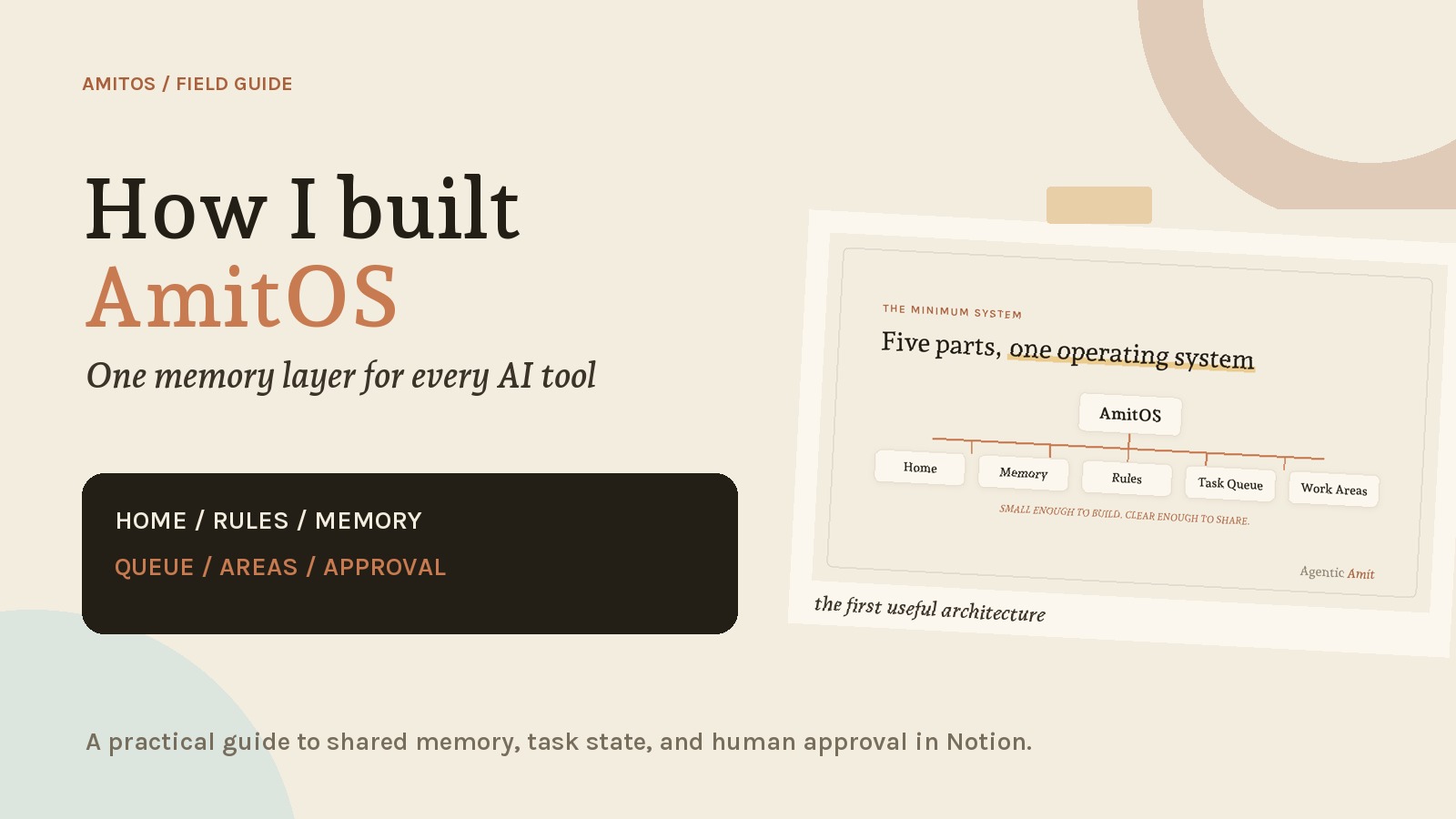
How I built AmitOS: one memory layer for every AI tool
I use Claude, ChatGPT, and Codex every day. But I do not let any one of them own the memory.
That decision is the foundation of AmitOS.
The problem was not access to better models
My notes existed. The frustrating part was continuity.
Every new thread needed another briefing. A decision made in one tool was invisible in another. A draft could be current in one conversation and stale everywhere else. I had useful tools, but no shared starting point, no common work state, and no explicit approval boundary.
I did not need a longer system prompt. I needed a small operating system outside the model.
The change I made on July 6
On July 6, 2026, I made Notion the source of truth for AmitOS.
Every agent now begins from the same Home page. From there it reads the relevant operating rules, durable memory, work area, and task record before it starts building.
The point is not to make Notion imitate a model. The point is to give changing models a durable place to read and update context.
The first useful version only had five parts
1. Home
Home is the router. It tells the agent what AmitOS is, where the canonical rules live, and which work area owns a task.
2. Operating Rules
Rules describe behaviour that should survive across projects: how to write, how to file work, what the agent may do autonomously, and where it must stop.
3. Memory
Memory stores durable facts and pointers. It is intentionally not a transcript archive. Facts that change future decisions belong here. Chronological detail belongs in Daily Notes or a Work Area.
4. Task Queue
The queue is the control plane. It gives every tool the same answer to three questions: what is being worked on, what state is it in, and what needs to happen next?
The lifecycle is:
Queued -> Triaged -> In Progress -> Needs You -> Approved -> Done
The minimum fields are Task, Status, Area, Type, Due, Deliverable Link, Needs From You, Created, and Updated.
5. Work Areas
Work Areas hold domain-specific context and artifacts. Agentic Amit, consulting, real estate, and other parts of my work can keep their own material without creating separate operating systems.
The most important field is Needs You
An agent can research, analyse, draft, organise, and build reversible artifacts.
It stops before anything is sent, published, signed, charged, purchased, deleted, or otherwise made irreversible. The task moves to Needs You with the exact decision required from me.
That boundary is not a polite reminder buried in a prompt. It is a visible state in the workflow.
What survives when the tool changes
Claude can begin a task. ChatGPT can shape the draft. Codex can build and verify the artifact. Each tool reads the same durable context and updates the same work record.
The models still have different strengths. AmitOS does not erase that. It removes the need to reconstruct the operating context every time I change tools.
The model can change. The context survives.
Build the smallest version first
Do not begin with a giant second brain.
Create Home, Operating Rules, Memory, one Task Queue, and one Work Area. Add the exact six statuses. Paste the bootstrap instruction into your agent workflow. Then run one real task from Queued to Done.
If the agent can enter the system, find the right context, produce a useful artifact, stop at the approval gate, and file the final result, the architecture works.
Only add another database when a real task proves you need it.
Get the full build pack
The field guide includes the five-part architecture, exact Task Queue schema, bootstrap instruction, dry run, and failure-mode checklist.
Evidence note
This article documents the architecture currently used in AmitOS. It was checked against the canonical Home, Memory, Agent Operating Protocol, Task Queue, and Agentic Amit script 18 on July 15, 2026. It describes a personal operating system, not a universal benchmark or an official framework from Notion, Anthropic, or OpenAI.
Filed under: AmitOS, Agentic AI, Notion, AI Systems