Insight · July 14, 2026 · 10 min read
What to do when your mind goes blank in an interview
I got stuck in my Google interview and got the job anyway. This is the four-part recovery framework I would practice today.
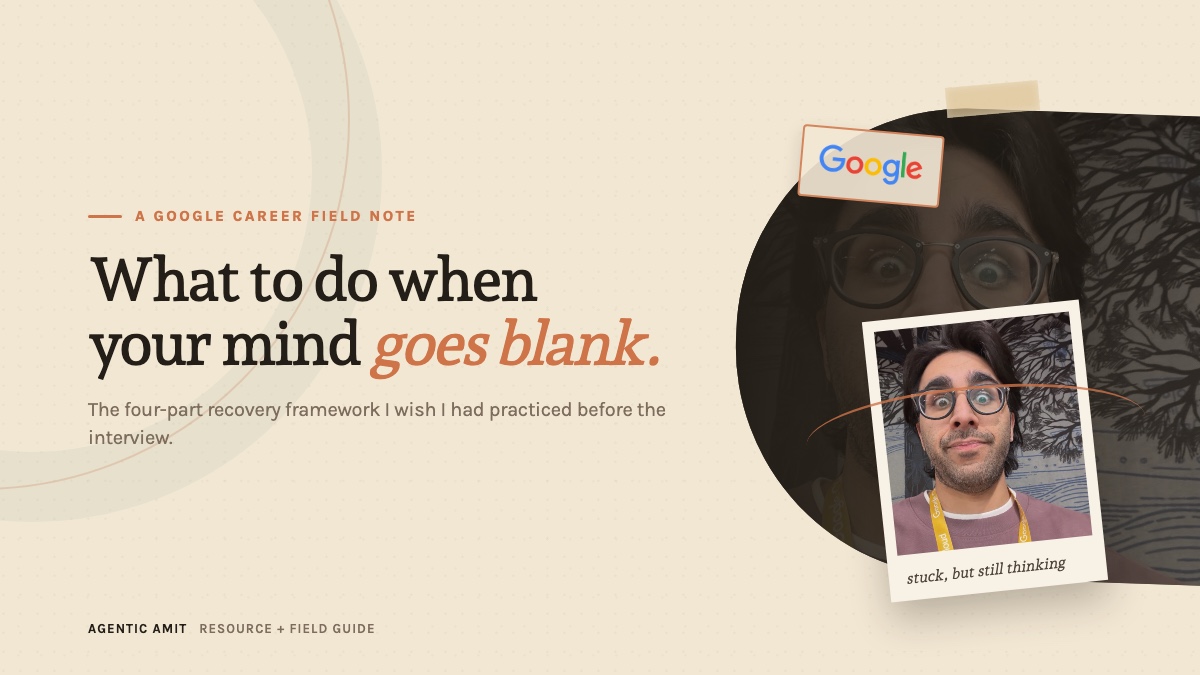
What to do when your mind goes blank in an interview
I got stuck in my Google interview.
There was a question, then a pause, then the particular kind of silence that makes every second feel longer than it is.
I remember understanding enough of the problem to know I should be doing something. I also remember trying to protect myself from saying the wrong thing. So I kept too much of the work inside my head.
That silence felt like safety.
It was not. It was hiding the exact thing the interviewer needed to evaluate: how I was thinking.
I still got the job. Looking back, the important lesson was not that getting stuck does not matter. It was that a difficult moment does not have to become the end of your answer. Recovery is a skill, and you can practice it before the pressure arrives.
The framework I would use today has four parts: visible thinking, clarification, trade-offs, and recovery.
1. Make your thinking visible
An interview answer is not only a test of whether you reach the right destination. It is also a chance to show how you navigate when the route is unclear.
If all of your reasoning stays internal, the interviewer can only see two states: silence and final answer. They cannot tell whether you are testing a smart hypothesis, noticing a constraint, or simply lost.
Visible thinking closes that gap.
You do not need to narrate every mental twitch. You need to expose the parts of the reasoning that help another person follow and evaluate your approach.
A useful sequence is:
- Notice: state the first relevant feature of the problem.
- Hypothesis: offer a tentative explanation or direction.
- Test: explain how you would check it.
- Gap: name what you still need to understand.
That can sound like:
The first thing I notice is...
My working assumption is...
I would test that by...
The part I am uncertain about is...
These phrases are simple on purpose. Under pressure, simple language is useful language.
Visible thinking does not mean pretending to know. In fact, it makes uncertainty more credible because you are showing its boundaries. “I do not know” ends the trail. “I am not sure yet, but here is how I would reduce the uncertainty” gives the conversation somewhere to go.
2. Clarify the real problem before solving it
When candidates are nervous, they often hear a question and sprint toward an answer. Speed feels productive. Sometimes it is just a fast way to solve the wrong problem.
Before choosing an approach, clarify three things:
- Goal: What outcome are we optimizing for?
- Constraints: What limits, requirements, or dependencies matter?
- Success: What would make the answer good enough in this context?
For a product or design question, that may mean asking which user matters most, what stage the product is in, or which metric defines success.
For a technical question, it may mean clarifying scale, latency, consistency, available data, or acceptable complexity.
For a behavioural question, it may mean checking which part of the experience the interviewer wants you to focus on.
A concise setup can sound like this:
Before I solve it, I want to make sure I am solving the right version of the problem. The goal is [X], we are constrained by [Y], and success would look like [Z]. Is that the right frame?
This is not stalling. It demonstrates judgment.
The strongest answers are not usually the answers with the most information. They are the answers that make good decisions about which information matters.
3. Explain what the answer costs
A recommendation without a trade-off is usually a preference wearing a suit.
Real decisions have costs. A faster approach may be harder to maintain. A flexible system may be more complicated. A highly scalable design may be unnecessary for the current stage. A polished experience may take longer to validate.
Interviewers often learn more from how you handle those tensions than from the option you choose.
Use this structure:
- State the option you prefer.
- Name the requirement it serves.
- Identify what it gives up.
- Explain what new information would change your choice.
For example:
I would choose Option A because the immediate requirement is speed to learn. That trades away some flexibility, which I think is acceptable at this stage. If the expected scale or integration surface were larger, I would reconsider Option B.
Notice what this answer does not claim. It does not claim there is one universally correct choice. It shows that the choice is connected to context.
That is the heart of a good trade-off discussion: not just what you chose, but why the cost is acceptable here.
4. Treat recovery as part of the interview
The moment your mind goes blank, you are likely to have two problems:
- The original question.
- Your reaction to being stuck.
The second problem can quickly become larger than the first. You start judging the pause, imagining the outcome, and searching for the perfect sentence that will erase the last thirty seconds.
You do not need a perfect sentence. You need a small recovery loop:
- Pause. Take one breath instead of filling the silence with noise.
- Restate. Say what you believe the problem is asking.
- Ask. Request the missing context or confirm an assumption.
- Adapt. Use the response, including a hint, as new information.
- Continue. Take the next visible step.
Useful recovery language includes:
Let me restate the problem to make sure I have the right frame.
I am deciding between two approaches. The main difference is...
I think I made an assumption that may not hold. Can I revisit it?
That hint changes my approach because...
That last phrase matters. A hint is not evidence that you have failed. It is a chance to show that you can absorb information and update your reasoning.
In actual work, people rarely succeed by knowing everything before the conversation begins. They succeed by listening, adjusting, and moving again. An interview can reveal the same skill.
What not to practice
Many people prepare for interviews by collecting perfect answers. There is some value in knowing the common shapes of a question, but memorization can become fragile.
Do not only practice:
- Giving an uninterrupted answer you already know.
- Hiding uncertainty until you have resolved it privately.
- Treating clarification as weakness.
- Treating hints as a score against you.
- Racing to fill every pause.
Those habits make practice feel smooth and the real interview feel unusually threatening.
Instead, practice the messy parts deliberately.
A three-round rehearsal
Choose one problem you do not already know how to solve. Then run it three times.
Round 1: Narrate
Speak your reasoning out loud. Use the notice, hypothesis, test, and gap sequence. Record yourself if you can. Listen for long stretches where the work disappears into your head.
Round 2: Add ambiguity
Have a friend remove a requirement or introduce a vague constraint. Your job is not to guess what they meant. Your job is to clarify the goal, constraints, and definition of success.
Round 3: Inject a hint
Ask your partner to interrupt with new information. Practice saying what the hint changes, revising an assumption, and continuing without apologizing for the update.
The goal is not to make getting stuck impossible. It is to make recovery familiar.
The real signal
When I think about that Google interview now, I do not think the lesson is “say more.” Noise is not reasoning.
The lesson is to make the useful parts of your thinking available to the other person.
Clarify before you commit. Explain the cost of your choice. Let new information change you. And when your mind goes blank, do not try to teleport to the perfect answer.
Take one visible step.
Then another.
What the evidence supports
This four-part framework is my synthesis. It has not been tested as one complete intervention, and it is not Google’s official rubric. The evidence supports individual pieces of it, with important boundaries.
Interview anxiety is more than feeling nervous
McCarthy and Goffin developed the Measure of Anxiety in Selection Interviews using a student sample of 212 people, then tested it with 276 job applicants in a field setting. They identified five dimensions: communication, appearance, social, performance, and behavioural anxiety.
That matters because “calm down” treats interview anxiety as one vague feeling. A more useful diagnosis is specific. Are you losing the ability to communicate? Worrying about how you look? Comparing your performance with other candidates? Freezing behaviourally?
The recovery loop in this guide mainly targets communication, performance, and behavioural anxiety. It gives you a next action when your attention starts collapsing inward. It is not treatment for severe anxiety, and it does not make the other dimensions disappear.
Thinking aloud can reveal attended information
Ericsson and Simon’s classic work on verbal reports described how people can verbalize information they are already attending to in short-term memory. Their analysis also made an important distinction: asking someone to report what they are noticing can preserve the process better than asking for elaborate explanations that require them to generate new information.
That is why “visible thinking” should be concise. Name the observation, working assumption, test, and gap. Do not turn the interview into a running documentary about every feeling in your head.
The research supports verbal reports as useful data under the right instructions. It does not prove that talking more automatically improves interview scores.
Reframing arousal can be more useful than fighting it
Across experiments involving karaoke singing, public speaking, and math performance, Alison Wood Brooks found that participants who reframed anxiety as excitement performed better than participants instructed to calm down. The intervention could be as small as saying “I am excited.”
An interview is not identical to those tasks, so I would not turn this into a magic phrase. The useful mechanism is that anxiety and excitement are both high-arousal states. Moving from threat to opportunity may be easier than trying to force high arousal into perfect calm.
In practice: acknowledge the activation, take one breath, and give it a job. “I care about this. Let me restate the problem and take the next step.”
Structured criteria matter more than charisma
The U.S. Office of Personnel Management defines structured interviews around the same predetermined questions, the same order, and the same rating standards for every candidate. The goal is more accurate and consistent assessment of job-related competencies.
Candidates rarely see the exact rubric. You can still practice against explicit criteria: Did I clarify the problem? Did I make my reasoning observable? Did I explain a trade-off? Did I update when new information arrived?
That is the logic behind the rehearsal scorecard in the PDF. You are replacing “Did that feel impressive?” with behaviours you can actually review.
Source notes
- McCarthy, J., & Goffin, R. D. (2004). Measuring job interview anxiety: beyond weak knees and sweaty palms. Personnel Psychology, 57(3), 607-637.
- Ericsson, K. A., & Simon, H. A. (1980). Verbal reports as data. Psychological Review, 87(3), 215-251.
- Brooks, A. W. (2014). Get excited: reappraising pre-performance anxiety as excitement. Journal of Experimental Psychology: General, 143(3), 1144-1158.
- U.S. Office of Personnel Management. Structured interviews.
Practice the framework
I turned the four skills into a nine-page field guide with exact recovery phrases, trade-off prompts, a three-round rehearsal plan, and evidence notes with limitations.
Download the companion resource: The Interview Recovery Framework
This is based on my personal interview experience. It is not Google’s official interview rubric, and interview formats vary by role and team.
Filed under: Google Interview, Interview Tips, Visible Thinking, Career Growth, Recovery