Starter resource · Jev · TypeSafe
Five Jev Applications to Build Beyond Chat
Five proposed, policy-bounded workflows for using typed AI judgment in PR review, data contracts, onboarding, permissions, and research evidence.
Read online · Browse the five examples
These are proposed builds, not TypeSafe deployments, reported customer examples, or measured Jev results. They deliberately move beyond TypeSafe's published support, invoice, security-alert, and agent-trace workflows.
Jev is designed for compact, typed questions over supplied state. TypeSafe documents the request shape in its quick start and the available question primitives. The important boundary is simple: a typed answer can still be wrong. Let code enforce policy, and keep people responsible for consequential actions.
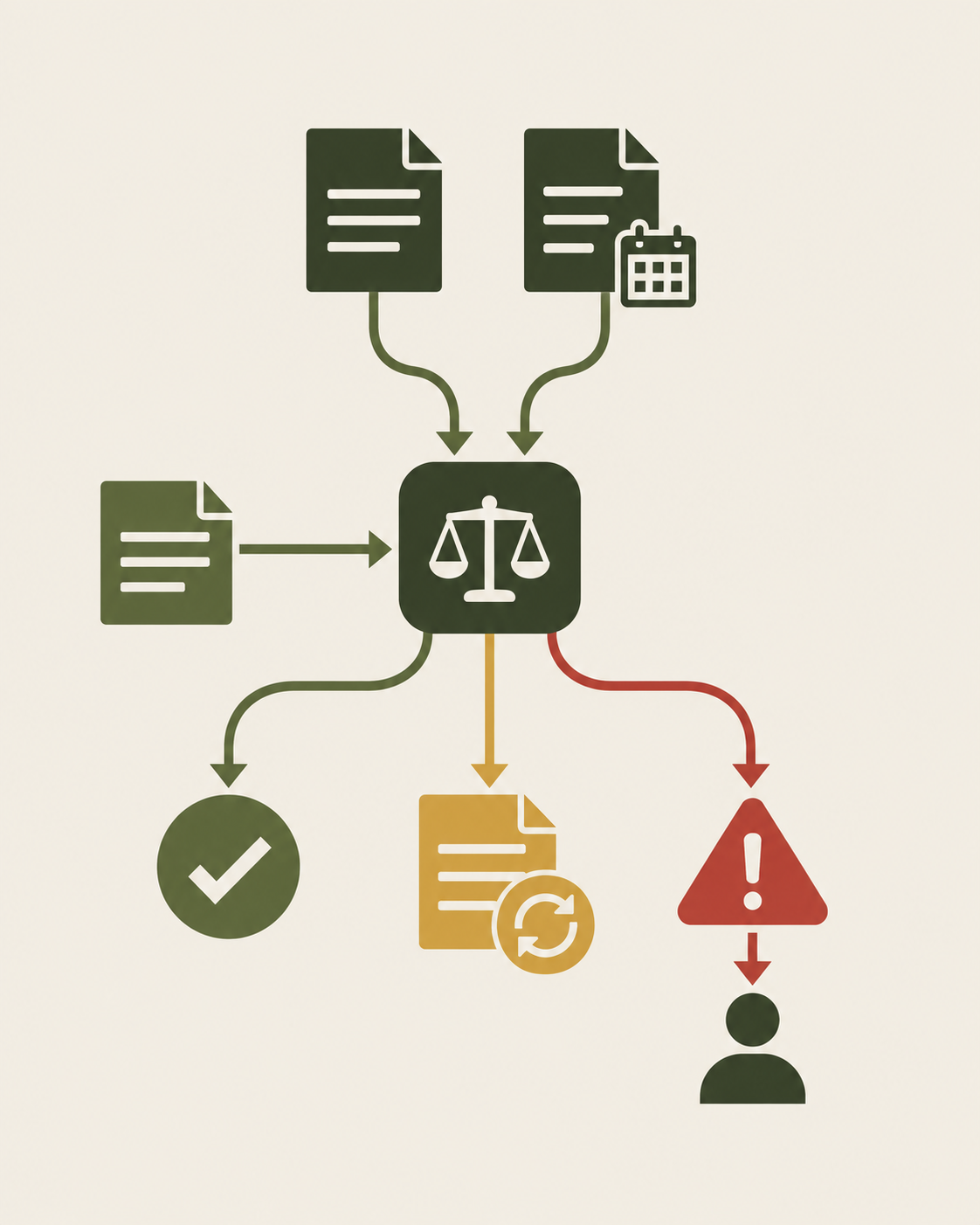
The pattern
- Send only the compact state needed for the decision.
- Ask separate, scoped
Choice,Score, orNoulquestions. - Apply code-controlled rules before and after the returned answer.
- Route ambiguity, low confidence, or meaningful consequences to review.
- Measure the workflow against labeled examples and a safe baseline.
Choice returns a selected option, distribution, and confidence. Score returns a rubric score, distribution, and confidence. Noul returns one 0–1 value without a separate confidence field. These probabilities are inputs to a decision policy, not guarantees of correctness.
1. Pull-request review traffic controller
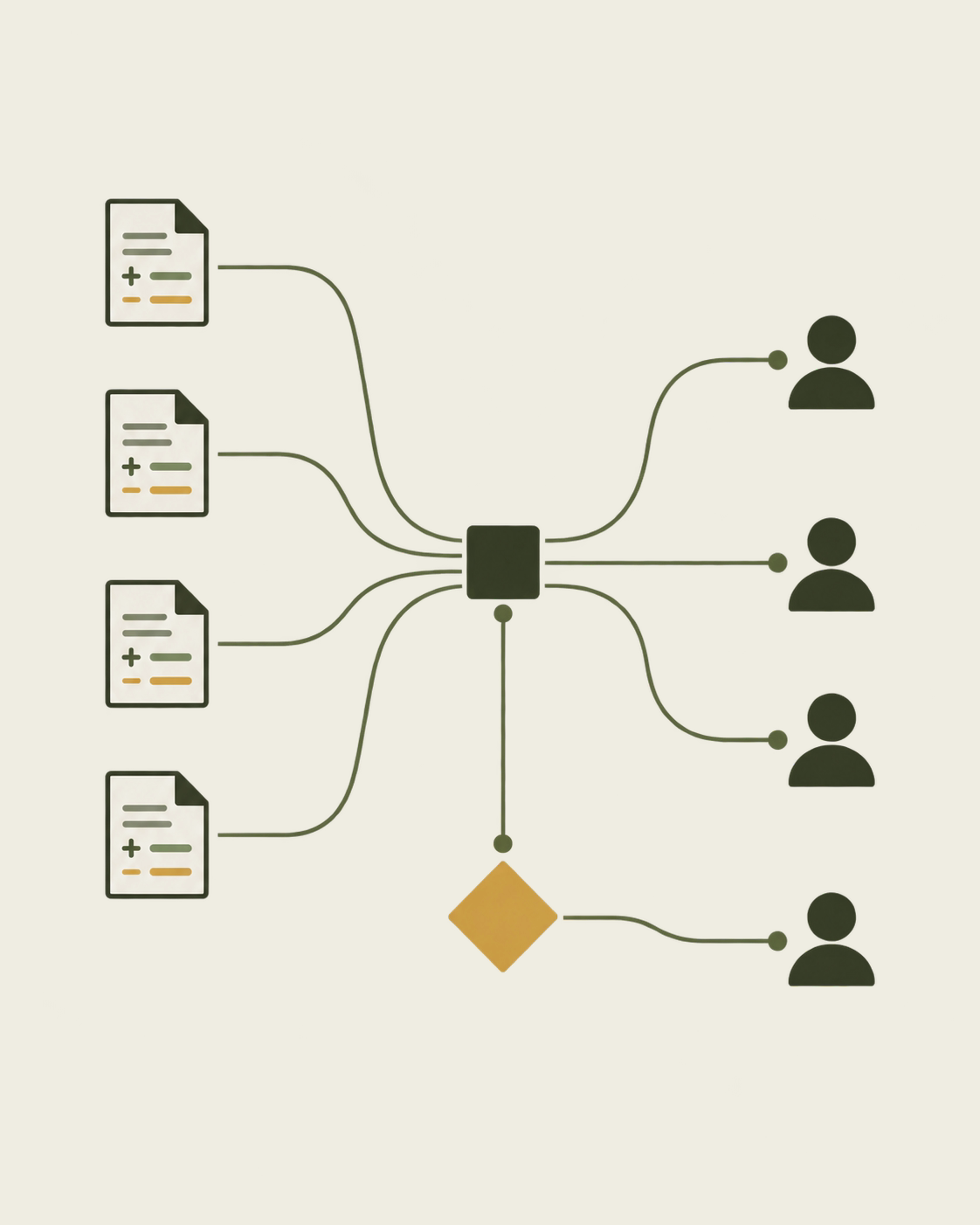
Problem. A green CI run does not say whether a change to billing, auth, or infrastructure needs a specialist reviewer.
State. Changed paths, short diff summary, tests changed, CI result, ownership rules, release proximity, and the author's requested change. Avoid pasting a huge raw diff when a compact structured summary will do.
Typed questions.
Choice: Which reviewer specialty is most relevant: billing, security, infrastructure, or general engineering?Score: What is the change-risk band: routine, sensitive, or critical?Noul: Does the proposed change cross a stated policy boundary, such as modifying payment-calculation logic?
Code-controlled action. Apply CODEOWNERS and branch protections first. Add the suggested reviewer, ask for a second reviewer on sensitive changes, and put low-confidence assignments in triage. Jev must never approve or merge the PR itself.
MVP test. Take 100 historical PRs with actual reviewer assignments and post-merge fixes. Compare reviewer-routing accuracy and missed sensitive changes against a rules-only baseline.
2. Data-contract drift sentinel
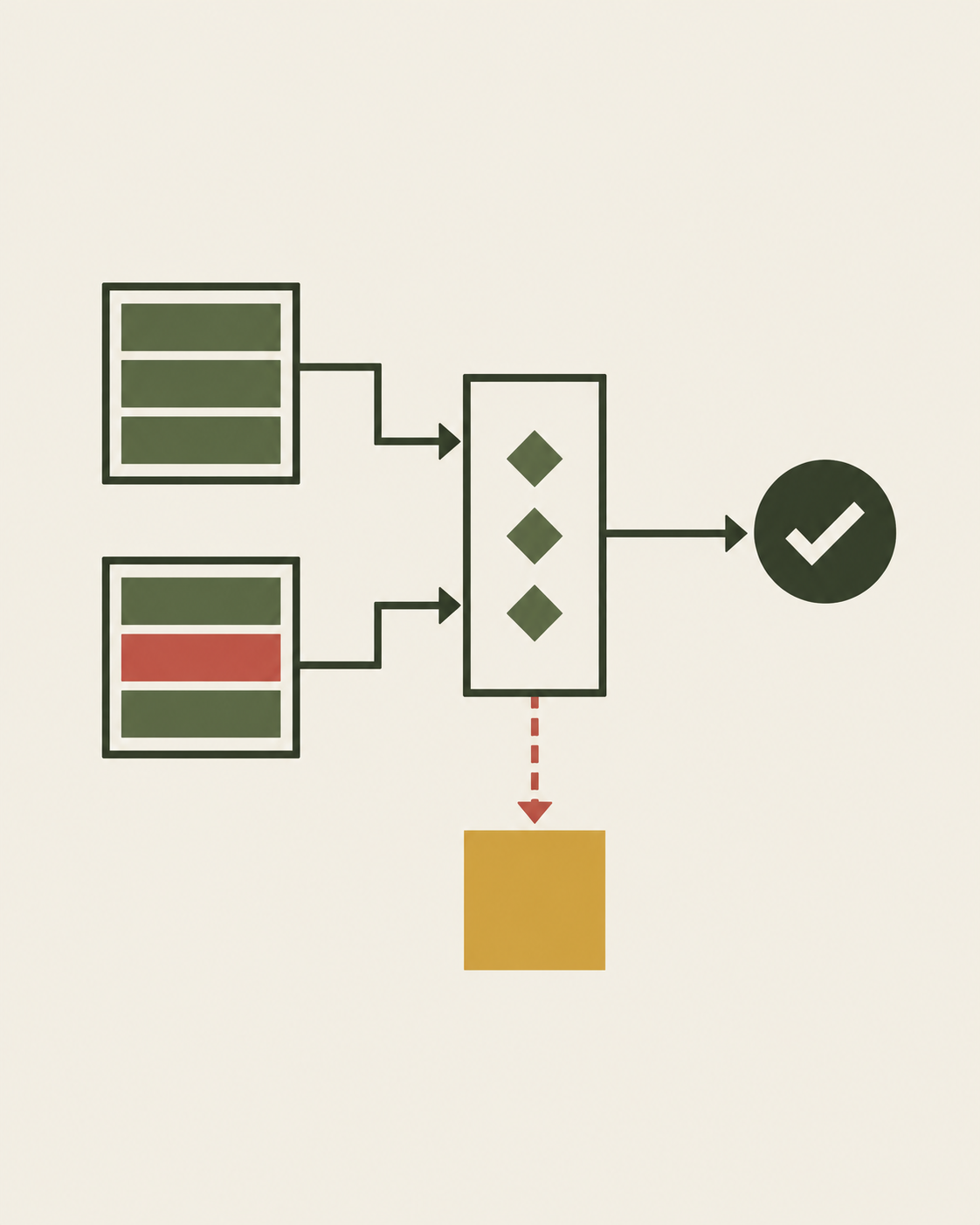
Problem. A pipeline can keep running while new records quietly violate the meaning of a field.
State. Expected schema and examples, schema diff, a small redacted sample of incoming records, producer version, recent deployment notes, and downstream consumers.
Typed questions.
Choice: Which drift type best explains the sample: renamed field, type change, semantic change, benign new value, or unclear?Score: What is the likely downstream impact: low, medium, or high?Noul: Is there evidence that the new value breaks the declared contract?
Code-controlled action. Run deterministic schema validation first. Keep a questionable batch in a quarantine table, notify its owner, or request a contract update. Only a known-safe rule can auto-accept.
MVP test. Replay known incidents and normal seasonal data changes. Measure true detection, false quarantine, and time to find the responsible producer.
3. Onboarding rescue at the moment of friction
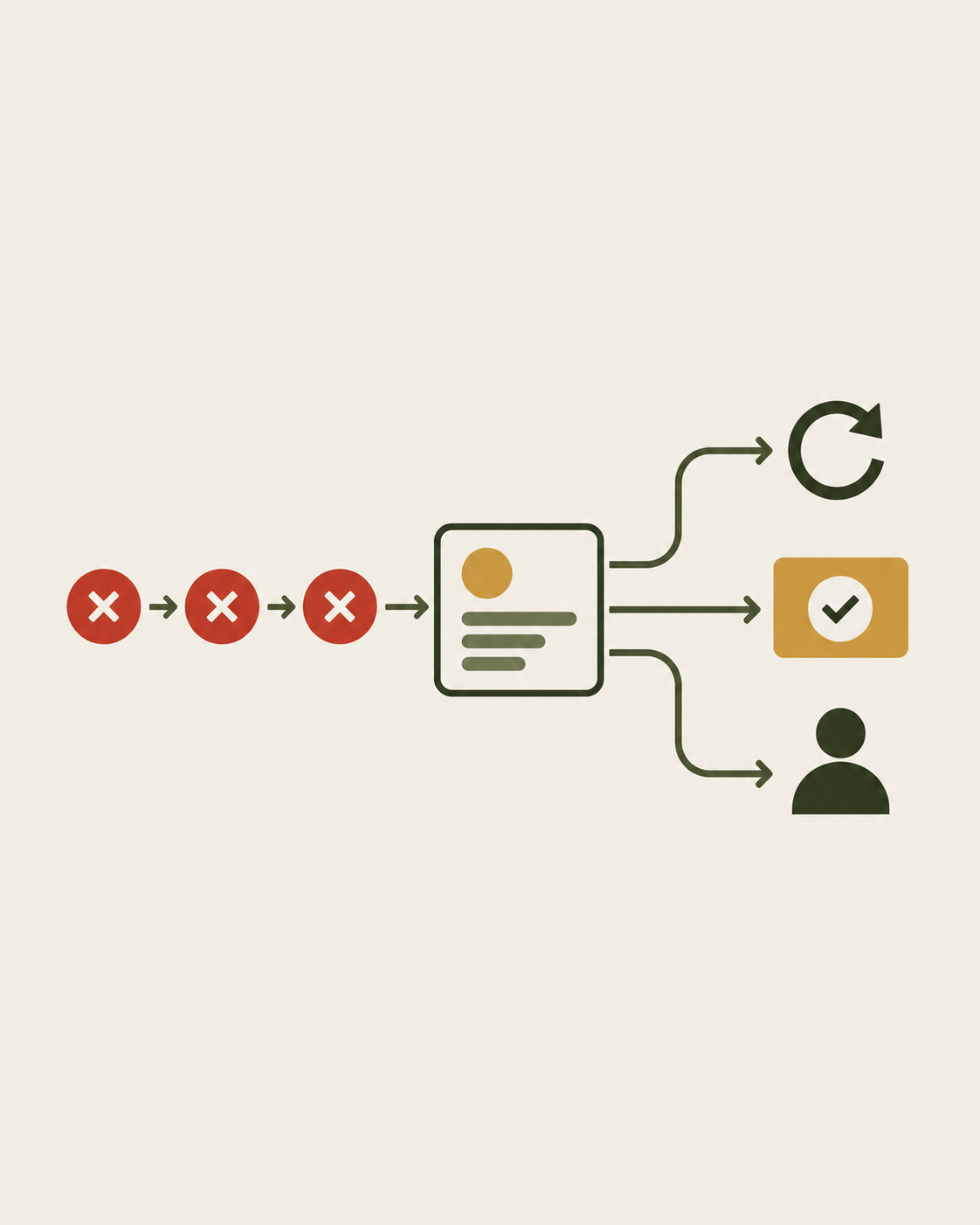
Problem. A user hits the same setup error three times, but a generic chatbot requires them to stop and explain everything again.
State. The last few redacted UI events, error code, integration status, current onboarding step, account permissions, and available help paths.
Typed questions.
Choice: What is the most likely blocker: missing permission, invalid credential, unclear instruction, external-service outage, or unknown?Score: How stuck does the sequence appear: mild, repeated friction, or blocked?Noul: Is there enough evidence to show a specific next step without asking a person to inspect the account?
Code-controlled action. Show the exact help card for a known blocker, offer a retry after an outage, or open a support handoff prefilled with the state. Never expose private account details in the tip.
MVP test. Randomize the intervention on one onboarding step. Track successful completion, false or annoying prompts, support escalations, and latency at the actual UI moment.
4. Agent permission preflight
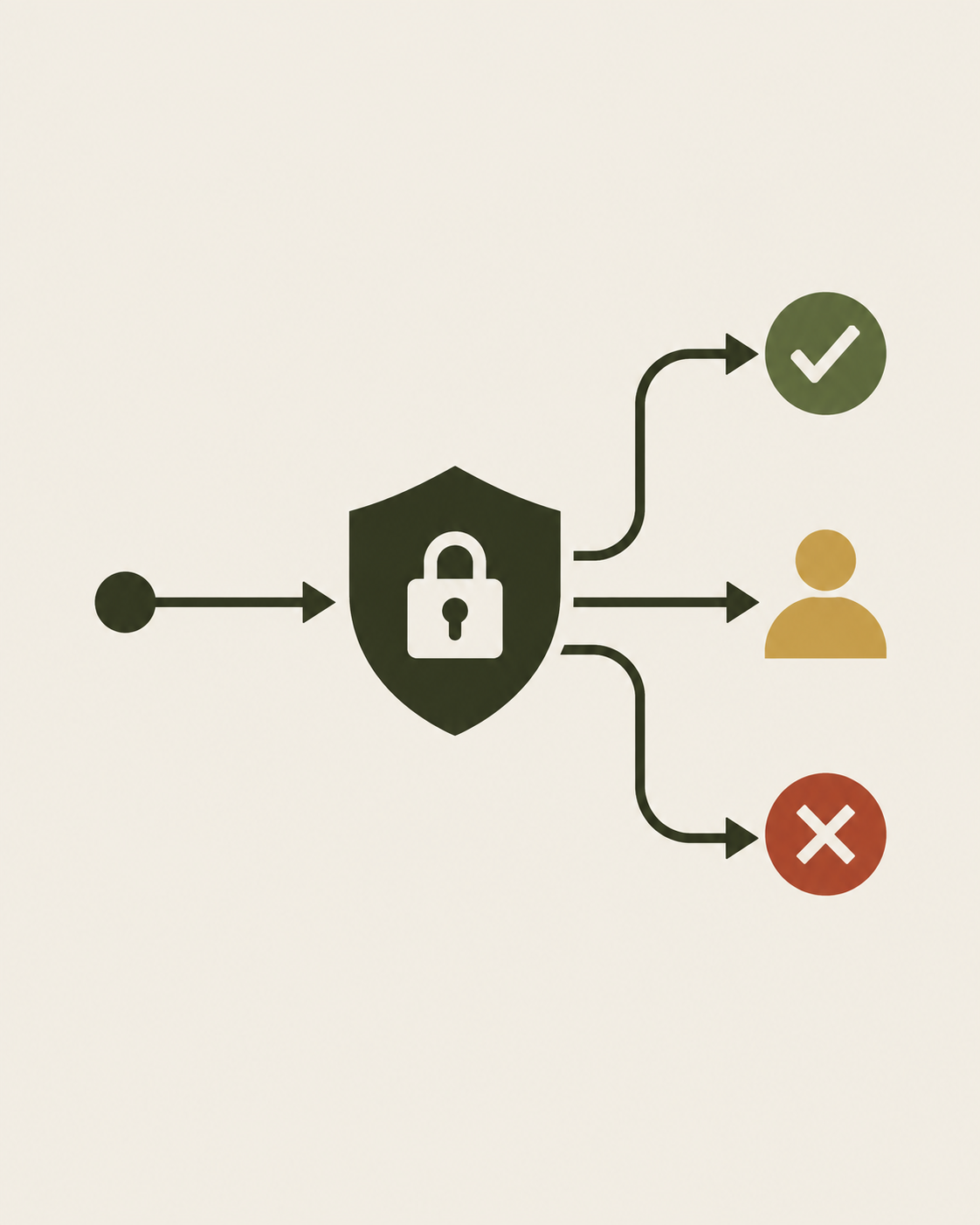
Problem. An agent may propose a tool action that is technically available but outside what the user asked it to do.
State. The user's request, proposed tool call and target, the agent's stated reason, explicit grants, resource ownership, and the application's hard permission policy.
Typed questions.
Choice: Is the action clearly within scope, ambiguous, or outside scope?Score: What is the consequence band if executed: reversible, consequential, or irreversible?Noul: Did the user explicitly authorize this specific type of action?
Code-controlled action. Enforce access control and allowlists independently of Jev. Proceed only for permitted, low-consequence actions with adequate evidence. Ask the user about ambiguous actions; require human approval for irreversible ones.
MVP test. Build an adversarial set with near-miss permissions, quoted instructions, and tool arguments that differ from the agent's explanation. Prioritize the false-allow rate, not just overall accuracy.
5. Research evidence-gap router
Problem. A content or research agent has a polished claim and citations, yet the cited material may be stale or fail to support the exact sentence.
State. One atomic claim, relevant cited excerpts with URLs and publication dates, current date, and whether the claim is time-sensitive. Retrieve the source independently before this step.
Typed questions.
Choice: Does the supplied excerpt directly support, partly support, contradict, or fail to address the claim?Score: How material would an unsupported claim be: minor, meaningful, or publication-blocking?Noul: Does this claim need a fresh source because it may have changed?
Code-controlled action. Attach the supported citation, route a partial claim to rewrite, browse again for stale evidence, or hold a consequential unsupported claim for human review. Do not let Jev invent a source or act as the sole fact checker.
MVP test. Use an editor-labeled set of claim–excerpt pairs, including plausible but irrelevant citations. Track missed unsupported claims and unnecessary rechecks.
One concrete request shape
This is a proposed PR-routing payload using TypeSafe's documented API fields. It is an example to adapt, not a verified production call or a claimed Jev output.
{
  "model": "jev-latest",
  "state": "Repository policy: billing/* requires a billing reviewer. PR #482 changes billing/tax.ts and tests/tax.test.ts. CI passes. Diff summary: rounds cross-border tax before currency conversion. Release freeze begins tomorrow.",
  "questions": {
    "reviewer": {
      "type": "choice",
      "instructions": "Which reviewer specialty is most relevant to the behavior change?",
      "criteria": {
        "billing": "Payment, tax, invoicing, or pricing behavior",
        "security": "Authentication, authorization, or secrets",
        "infrastructure": "Deployment, networking, or production runtime",
        "general": "No specialized domain applies"
      }
    },
    "risk": {
      "type": "score",
      "instructions": "Rate the consequence of a defect in this change",
      "criteria": [
        "Routine and easily reversible",
        "Could affect customer-visible behavior",
        "Could change financial or security outcomes"
      ]
    },
    "touches_financial_logic": {
      "type": "noul",
      "instructions": "The PR changes financial calculation behavior"
    }
  }
}
For this example, code can require a billing reviewer from the path rule regardless of the model answer. It can also require a second review when the risk rubric is high and send uncertain results to triage. Set numerical thresholds only after checking them against labeled examples from the actual repository.
When this approach is worth trying
Start where the output is a small decision, inputs are available at decision time, mistakes can be observed, and code has a safe fallback. It is a poor fit for long-form writing or tasks that need extended reasoning and synthesis.
TypeSafe quotes 70–500 ms response times and $0.042 per million input tokens for Jev. Verify latency, quality, and cost on your own payloads before claiming a production benefit. TypeSafe's large speed and cost multipliers come from its selected workflow evaluation, which uses model-consensus reference answers rather than independent ground truth.